Rating: 4 stars
The doll existed before the kidnapping.
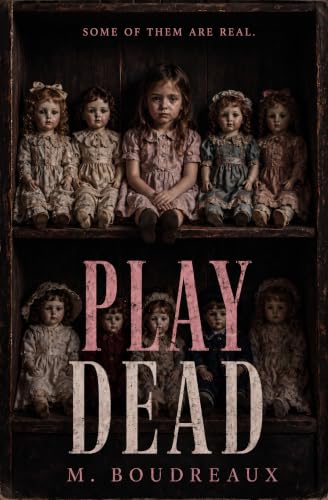
Eighteen months after five-year-old Mia Dawson disappeared, her mother sees her again on a stranger’s livestream. She is sitting at the end of a child-sized table in a yellow chair, surrounded by hyper-realistic dolls, while thousands of viewers watch. The woman behind the camera calls her Annie. Kate knows better. She recognizes the split in Mia’s thumbnail, the notch in her ear, and the tiny details no artist should have been able to recreate by accident.
Nicole Perry has built an enormous online following around her seventeen “children,” complete with birthdays, favorite foods, bedtime routines, family photographs, and personalities her followers know by heart. Annie has been part of that family since before Mia vanished, which should make Kate’s theory impossible. Then the girl moves again. Police search Nicole’s home and find exactly what Nicole says they will find: dolls. Kate is left with one choice. If she wants to know what is really happening inside that house, she has to get close enough to see it for herself.
Using a false name, Kate takes a temporary job inside Nicole’s carefully staged world. Behind the cameras, locked rooms, household rules, and perfectly arranged family moments, she discovers something far worse than a woman obsessed with lifelike dolls. Children are being taught new names, new memories, and new versions of themselves. They learn when they are allowed to move, when they are allowed to speak, and how to become perfectly still when the red light comes on. Beside each living child is a copy convincing enough to take their place.
Mia is alive, but she is no longer the five-year-old Kate has spent eighteen months trying to bring home. The deeper Kate gets into Nicole’s system, the more she realizes that finding her daughter was only the beginning. To get Mia out, Kate will have to survive a house built to make truth look like obsession, convince people who have already been taught what to believe, and face the possibility that loving the child who came home means letting go of the child she lost.
Play Dead is an uncanny psychological horror novel about missing children, manufactured memories, online spectators, and the terrifying power of a story repeated until everyone accepts it as truth. Sometimes the easiest way to hide a child is to put her where everyone can see her.
I received a digital copy of this book through the publisher on NetGalley for an honest review.
Play Dead was an interesting read that kept me engaged from start to finish. What I enjoyed most about this book was getting a glimpse into the world of a woman with such a large online following who collects silicone dolls. A woman who keeps her followers engaged by having them decide for her through her social media platforms when these dolls will eat and where they’ll sleep, not all of them knowing the impact such a choice has on these dolls. Because what some of her followers don’t know is that these silicone dolls look a lot like children who have gone missing. Silicone dolls were created months before these children disappeared, and the children were taught to behave like the dolls, so when the cameras rolled with them on the screen, the children were always hiding in plain sight so nobody would suspect anything was amiss. Learning how Nicole was able to accomplish this brought chills up and down my spine as I was reading Play Dead, but it also kept me engaged in the story as I wanted to see how this book would come to an end and all these children would be saved and brought home.
What also kept me reading was Kate. Yes, she annoyed me at times when she didn’t listen to the detective who was trying to help her with rescuing her daughter, but I also completely understood why. Kate figured out early on from watching that video that was sent to her about Nicole that the doll that looked like Mia was her daughter from very few fragments and didn’t want to take the chance of losing any opportunity she had to get her daughter back. So when an opening for getting into Nicole’s house came up, it made perfect sense that she jumped at the chance to take it. I also enjoyed that she did this too because it allowed us as the reader to get to see the inner workings of Nicole’s world when it came to the setup of her house with the dolls. Also, when she realized her daughter wasn’t the only one trapped in Nicole’s house, she decided she wanted to do everything she could to save all the children that were trapped in her house no matter what it took. So no matter what she did that annoyed me throughout the book, that right there made up for it for me.
I also enjoyed getting to see the dynamic between Kate, Mia, and the other two children who were in the house, Caleb and Sophie, as they were doing the best they could to get out of Nicole’s clutches. I know all of the children were doing the best they could to survive such awful circumstances, playing by Nicole’s messed-up rules when it came to everything they could and couldn’t do in the house. Which is why, when certain scenarios happened in the book, I wasn’t at all surprised by them and wasn’t upset with the child involved because they were just trying to survive a situation they found themselves in.
If there was anything about Play Dead I was annoyed with in particular, it would be how detailed the story would get at times. While I understood needing to know what was going on in Nicole’s house along with the rules these children had to live by, there were times when I felt like there was almost too much detail in this book. I get that certain aspects of the story need details, but there was certain information I was perfectly fine not needing to know that I felt like bogged down the story. It was great to find out, though, how all of this even started to begin with, so I appreciated that information being included here.
I also wasn’t the biggest fan of the ending either. Mostly because I wanted there to be more of what happened after the children got out of Nicole’s house. And I feel like the book just ends all of a sudden with no real conclusion that’s satisfactory to me as a reader.
Overall, though, I enjoyed reading Play Dead as it brought chills down my spine in a good way, and I never knew, with each page, the direction the story was going to go. I highly recommend this book to those wanting to read books with a thrilling mystery, especially anyone who enjoys reading books about missing children, as well as those who like books that involve people who livestream. And I think anyone who enjoys horror books involving dolls will enjoy this book too. Play Dead was published on September 22, 2026, for those interested in giving this book a read.


